To the parent who just heard the words “cerebral palsy”
I understand the confusion, grief and uncertainty that you’re feeling right now. Hearing the news that your child has Cerebral Palsy is tough – you’ll no doubt have endless questions and be feeling anger, guilt and everything in between.
If you take nothing else from this letter, please take this: your child being diagnosed with cerebral palsy is not your fault. Please know that cerebral palsy is almost never caused by anything a parent did or didn’t do so if you are carrying guilt, please stop. It isn’t your fault.
I was almost four when I was diagnosed, though my parents had long suspected cerebral palsy. My birth had been traumatic and upon arrival, I didn’t breathe independently for 25 minutes. My parents were assured everything was fine but they began to notice that I wasn’t reaching usual childhood milestones like sitting up on my own or taking my first steps. When the diagnosis was eventually confirmed, naturally there was fear – my parents had no idea what my future might look like. However, there was also relief to some extent – my parents’ suspicions had been confirmed and now they could begin understanding what support I might need and what life might look like moving forward.
Upon diagnosis, many parents start to grieve the future that they thought their child would have. Medical professionals often focus heavily on difficulties and limitations – the things that may not be possible. But your child’s future hasn’t disappeared – it’s just different. And different isn’t bad. Your child still has their unique personality, humour, stubbornness and determination – none of that is erased by a label. You just have more information but it doesn’t change who your child is.
As a child, there was one thing I never really expressed but often felt – guilt. I have two older sisters and a younger brother and I often felt guilty for the time my parents had to dedicate to me – taking me to endless appointments as well as the financial strain that my disability added. I never voiced it but it often niggled away at me.
Determination and resilience were instilled in me throughout my childhood – there was no such word as “can’t” in our house. I was always encouraged to try first and then ask for help. Even simple things like doing buttons and tying my shoelaces – I was always encouraged to give it a go and I’m so grateful my parents for taking that approach because it’s shaped my life. I’ve never shied away from a challenge and have always wanted to work hard to achieve my goals.
Humour was always so important in our family. Whenever I fell over as a child, people would expect mum and dad to run to me and wrap me in cotton wool. But mum would just call me a donkey and tell me to get up and dust myself off! We’d often make jokes and make light of my disability and that helped so much. It never felt like a big deal, my disability never defined who I was. As I moved into early adulthood, it became apparent that alcohol had a positive effect on my condition – I walked straighter and my speech was clearer! Not the effects you’d normally expect and I often joked a few vodkas were good for me!
Relationships and friendships were another challenging subject. I spent much of my childhood feeling slightly on the outside. I had friends, but I rarely felt a deep sense of connection or belonging. Sometimes it was small things that hurt the most. I remember feeling upset when my best friend asked my school assistant for a reference because she wanted to volunteer with to be a carer. I knew she meant no harm, but moments like that reminded me that even people close to me often saw my disability before they saw me. My friends would sometimes make plans for the weekend and the loneliness of not being invited often hurt.
I have often reflected on the hardest part of having a physical disability and I’ve come to realise that the physical barriers can often be overcome – it’s the attitudinal barriers that emotionally drain me. When strangers choose to speak over me because they don’t understand me or when employers turn me down because they think I’m not capable of working. When a bus driver gives me attitude because putting a ramp down requires a little bit of effort. Those are the moments that are difficult. And yes, sometimes I get upset and frustrated. But then I do as mum and dad taught me: I dust myself off and I keep going. That’s one of best things you can do for your child – acknowledge the frustrations, the difficult days but encourage them. Believe in them. And support them to fulfil their dreams – and ban the words, “I can’t”.
I think when my parents realised I had Cerebral Palsy, they initially saw a future in which they’d always be caring for me. The early predictions from the professionals were bleak – I wasn’t expected to manage in a mainstream school, let alone go on to live independently and support myself. At times, it was no doubt difficult for my parents to let go and allow me to develop that independence. It was difficult for me too – at each stage, I wondered, “Can I do this? What if I can’t?” I remember those insecurities when I moved to a residential college at the age of 16. But slowly, step by step, I pushed myself a little bit more and my confidence grew until eventually, I was living alone in an apartment and working full-time. Mum worried a lot – mainly about if I was eating properly but I was living the life I’d always wanted. You’ll always worry about your child – what parent doesn’t? But one of the greatest things you can ever do is allow them to develop as much independence as possible. Listen to how they see their future and do whatever you can to support that vision. It’ll be hard to step back, I know. But your child cannot build confidence if fear makes every decision for them.
I often thought about finding someone to settle down with and perhaps having a family – but it always felt like a far off dream that would never become reality. I wondered who would ever see beyond my disability. But after taking a chance with online dating, I met Dean. From our very first conversation, he wasn’t fazed. He didn’t make a big thing of my disability, we didn’t spend hours talking about it. He just accepted it as a part of who I was.
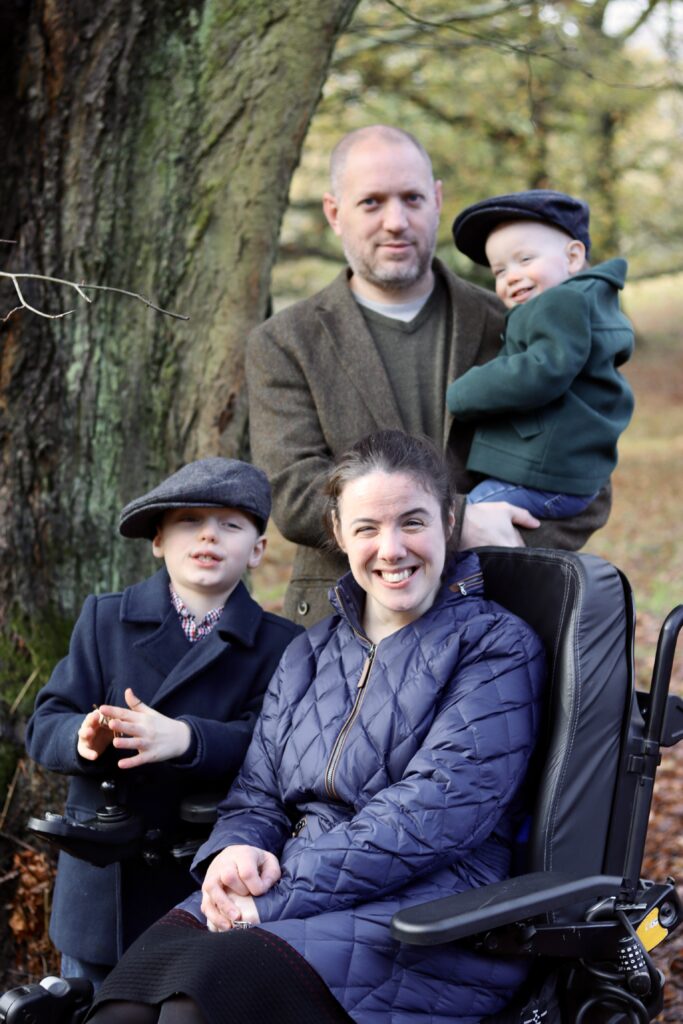
Three years later, we married and later welcomed our two boys – Jack and Niall. I had two relatively normal pregnancies and gave birth naturally. I’d always dreamt of having my own children but I’d feared it just wasn’t for me. When it became a reality, it was scary. There were things I struggled with physically – it isn’t easy for anybody to change a crying, wiggling baby. Add cerebral palsy into the mix and even the simplest parenting tasks sometimes became exhausting, chaotic and oddly comical! But I found my own ways of doing things and although Dean was around, I didn’t rely on him as much as I’d feared.
And the best bit? My boys don’t see a disabled mum. They just see Mum – the one who embarrasses them and cheers a bit too loudly in school assemblies. And here’s something I didn’t expect — my disability has actually shaped my parenting in positive ways. My boys are naturally aware of difference. They notice access. They question unfairness. They’ve grown up seeing that strength doesn’t always look loud or physical.
That’s what I want to say to you now. Your child’s future might not be how you imagined it. It might be totally different. It might involve adaptations. But love, partnership, family and purpose? None of those things are automatically off the table.
As a child, I think expectations of my future were limited. Many teachers and professionals underestimated what I was capable of and therefore, my future career options weren’t properly considered, but I knew I wanted to work and contribute. I deliberately chose a degree programme which had a work placement year as I wanted to develop my experience before graduating. Ironically, having experienced discrimination whilst seeking my work placement, I ended up working on a project which supported disabled people into employment. Today, I have built my own business – using my own lived experience to help others understand disability – through training, speaking and advocacy. In those early days after diagnosis, nobody could have predicted the path which lay ahead.
I’m not saying that life with Cerebral Palsy is easy or straightforward. There have been really difficult days – and there still are. Days when I feel exhausted. Days when access barriers and other people’s attitudes really grind me down. Days when managing everything and keeping a smile on my face seems impossible.
But if you asked me how my life has been happy and meaningful? I’d say I’ve been happy, fulfilled and extremely grateful for the experiences and opportunities that I’ve had, and continue to have.
Cerebral Palsy is a part of who I am – in a really positive way. It has shaped me, challenged me and influenced the direction my life has taken – but it has never stopped me from loving, laughing, achieving, working, parenting or building a positive future for myself.
So please, when people begin telling you what your child may never do, hold on to this instead: nobody can predict the life your child will have.
Let them grow.
Let them try.
Let them fail sometimes.
Let them surprise you.
Your child’s future may not look exactly how you imagined it would.
But it can still be joyful, fulfilling, ordinary, chaotic, funny, loving and beautiful.
And one day, you may realise that the life you feared for your child was never something to fear at all.
With love and understanding
Aideen Blackborough